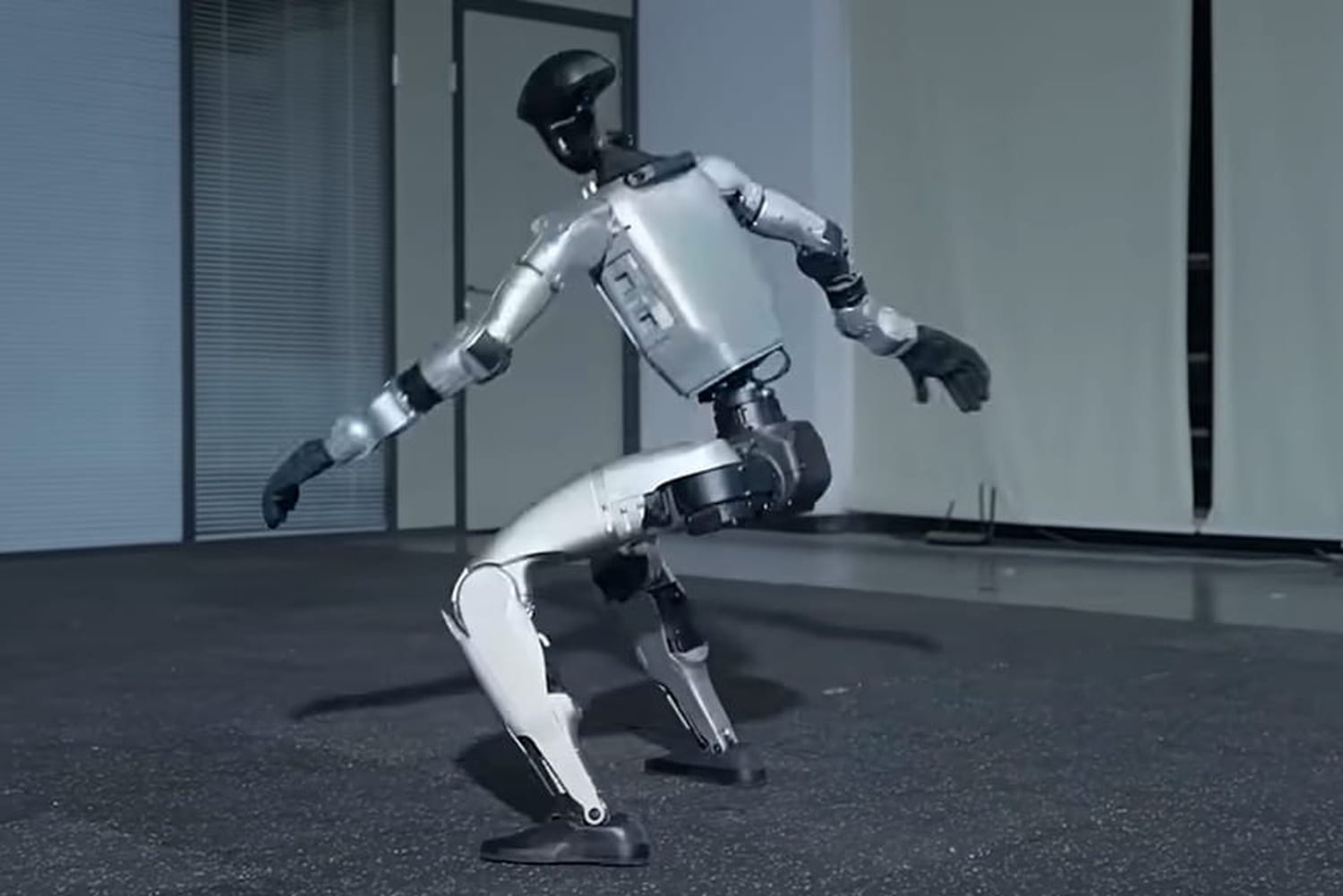
The Chinese company impresses with the capabilities of its robots, which play tennis as well as they practice kung fu, but also with its industrial mastery.
The images went around the world. Humanoid robots from Chinese manufacturer Unitree Robotics rose to global fame in February, during the Lunar New Year show. During this event watched by nearly a billion viewers, they performed a kung fu demonstration, impressing with their agility and coordination. The whole world was able to see the progress of Chinese robotics. These owe nothing to chance. Chinese leaders have made physical AI a priority, with the backdrop of not wanting the United States to take the lead.
Unitree is one of the champions that China is banking on to get ahead of American competition in the field of humanoid robotics, represented in particular by Tesla and Boston Dynamics. And the company has taken a step ahead, since it shares with the other Chinese player, AgiBot, first place in terms of global sales (more than 5,500 robots sold in 2025, according to the company), in a market that is still embryonic.
The low-cost strategy that is shaking up the sector
Founded in 2016 by Wang Xingxing, then 26 years old, Unitree positioned itself on an industrial approach consisting of offering robots at relatively accessible prices, with a logic of large-scale distribution. The company first made itself known by developing quadruped robots, strongly inspired by those of Boston Dynamics. But its different models (Go1, Go2, AlienGo and B1/B2) are offered at prices significantly lower (from $1,600) than those of the Americans ($75,000). More recently, Unitree unveiled the As2, presented as more efficient than its predecessors.
Since 2023, Unitree has started to develop humanoid robots. The first model, the H1, was presented as one of the fastest on the market, illustrating the progress made in dynamic locomotion. But it is above all the G1, highlighted during the Lunar New Year show, which marks a change of scale.
More compact, with its 1.27 meters and 35 kilos, it stands out above all for its price, very low for a humanoid robot: a little over 10,000 euros. At this stage, the models developed by Tesla, Figure AI or Agility remain significantly more expensive and mainly oriented towards industrial uses. By drastically lowering the barrier to entry, Unitree is helping to open up a new market.
To achieve this positioning, Unitree has chosen to manufacture relatively uncomplex but solid robots. “The fewer parts and simpler structure a product has, the easier it is to manufacture, and the more robust and durable it becomes,” Wang Xingxing told Time. For the humanoid robotics sector, this could be a turning point.
Above all, the company relies on the Chinese industrial ecosystem, which allows it to industrialize humanoid robotics on a large scale, in a logic comparable to that of DJI with drones. It also benefits from strong vertical integration, manufacturing many of its critical components in-house, including motors, gearboxes and controllers.
Uses in tourism and entertainment
For the moment, however, Unitree’s robots have limited capabilities, like most of their competitors. If they can prove effective in closed and predictable environments, we will still have to wait before seeing them evolve autonomously in open environments. Their skills thus limit them to applications such as entertainment, welcoming the public in stores or trade fairs, or even guide functions in tourist places.
The founder himself tempers expectations. Wang Xingxing believes that the technology remains at an early stage and that widespread adoption, which he called the “ChatGPT moment,” could come in two to three years. “For humanoid robots, market growth depends above all on the maturity of the technologies,” he told Chinese media 36kr in February. “As they gain in value and efficiency, the market as a whole is expected to gradually expand.”
At the same time, the AI models that constitute the “consciousness” of robots are advancing rapidly. The G1 was thus able to learn to play tennis from just five hours of data from the recording of a human player in motion capture.
Humanoid robotics, a priority for Beijing
Unitree today appears well positioned to establish itself as one of the major players in the humanoid robot market in the years to come. Wang
Like other Chinese robot manufacturers, the start-up can count on strong support from Beijing. China’s latest five-year plan places robotics, particularly humanoid robots, at the heart of the country’s industrial policy. China considers these technologies essential to support its growth, offset demographic decline and strengthen its technological sovereignty.
The ambition is to structure a complete ecosystem, ranging from hardware components to artificial intelligence software. Several tens of billions of euros of public and private investments are being mobilized to accelerate the development of the sector.
At the same time, American competition is intensifying. Tesla is preparing to ramp up production of its Optimus robot, while Figure AI and Agility are continuing their industrialization. Faced with these players, China is focusing on cost control, speed of execution and industrial integration. Humanoid robotics now constitutes a major field of competition between the Chinese and American superpowers.