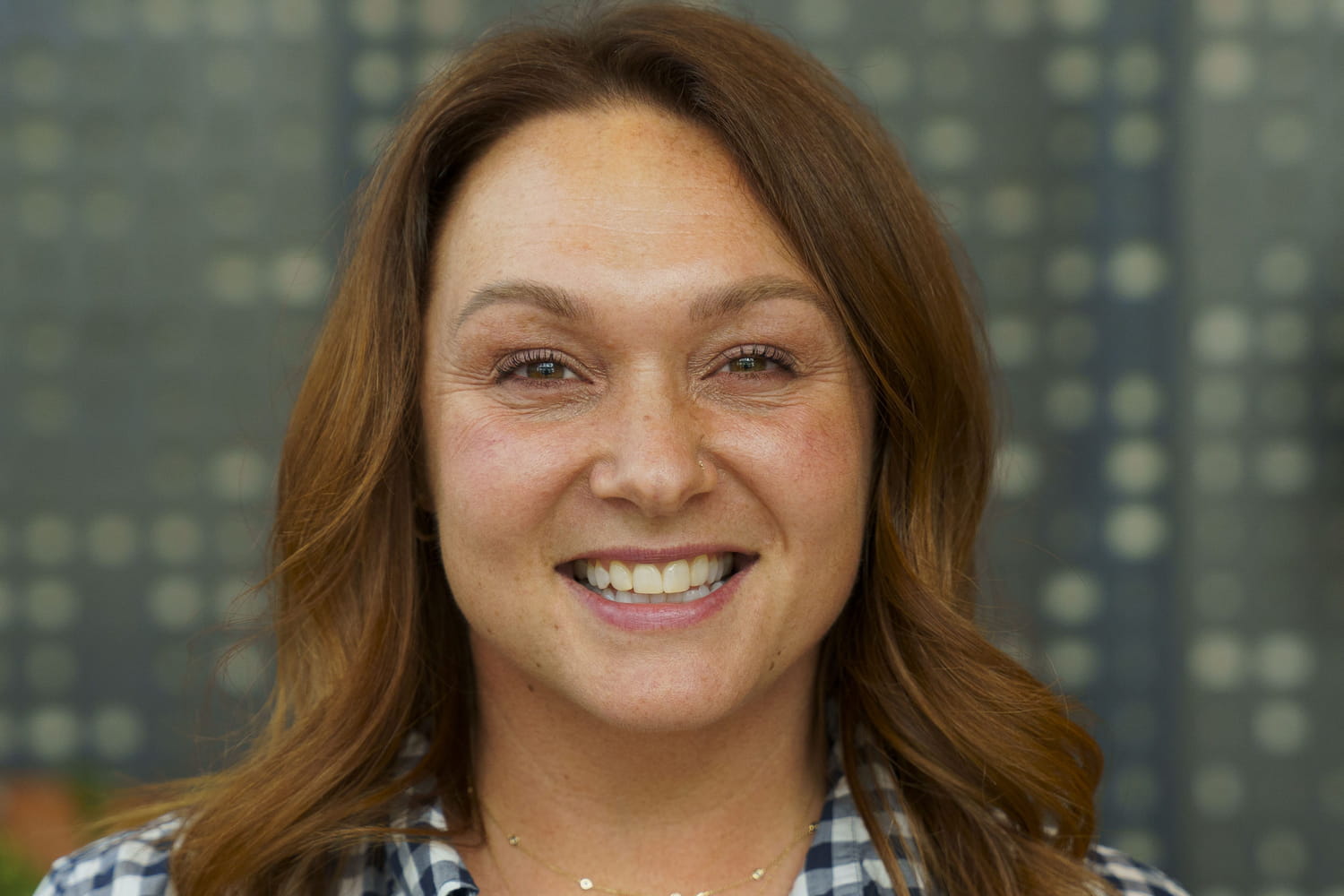
Met during the Machina show in Paris, the interim general manager of the most famous manufacturer of humanoid robots in the world, Amanda McMaster, details the company’s strategy to bring its robots into the era of industrial production.
JDN. For people who aren’t yet very familiar with Boston Dynamics, how would you describe the company’s mission?
Amanda McMaster. Boston Dynamics is an industrial company whose mission is to design robots that can improve people’s lives. This is truly our reason for being. The company was born at MIT around thirty years ago. It was founded by Rod Brooks and Marc Raibert. Until recently, Robert Playter was the CEO. Since our inception, we have focused on developing useful robots that can meet the needs of our customers, with an emphasis on commercial applications.
Can you tell us about the robots you are developing?
Our humanoid robot is called Atlas, while Spot is our quadruped robot. Atlas is still in the development phase. We are currently at version D1, for Development 1, which corresponds to the first development version of the robot. We presented it at CES in Las Vegas in January. Today, our priority is to build the datasets necessary for training our foundation models, in partnership with Google Deepmind. We are also working closely with Hyundai Motor Group, both to develop our robots and to prepare for their large-scale deployment.
Spot has been one of the most famous robots in the world for several years. What is its main application?
Spot is mainly used for industrial inspections. It is also employed in the field of public safety, notably by law enforcement and other response services. But it is truly in the industrial sector that we see the greatest potential. There is still a lot to do, but we are already seeing very concrete demand from our customers, who are starting to deploy the solution on a larger scale. We also believe that its use cases will continue to evolve. For example, if Spot already performs visual and thermal inspections in a facility housing high-value equipment, it could also provide nighttime perimeter surveillance missions. This helps improve our customers’ return on investment.
Atlas is transitioning from a research platform to a commercial product. What are the main challenges of this transition today?
The main challenge remains development, and especially the ability to have enough data to cover the different use cases. This is precisely why our collaboration with Google Deepmind and Hyundai is so important: it gives us access to the information we need to train our models. We have extremely talented engineers and I have every confidence in their ability to build something exceptional. Then, it’s all based on the big pillars we presented at launch: performance, reliability, security, customer ROI, artificial intelligence, data and the ability to scale. Our goal is to reach a cost level that allows our clients to obtain a return on investment in less than two years.
How do you collect the data that feeds the robots?
At Hyundai, we collect information directly from automobile production plants. We established the Robotics AI Application Center in Savannah, Georgia, near Hyundai Motor Group Metaplant America (HMGMA). This allows us to create data sets that are very specific to the industrial applications that we develop. At the same time, with Google DeepMind, we are building a much larger and more diverse set. We use different collection methods, directly in the field, at the heart of industrial operations, as well as other acquisition techniques. All of this data is then used to train and improve our robots.
Today, you are looking to produce most of your robots in the United States. What is your industrial strategy?
This is precisely where our membership in the Hyundai group constitutes a considerable advantage. For example, Hyundai Mobis will manufacture Atlas actuators in the United States. We are already seeing the benefits of this integration, which allows us to significantly reduce costs. We also have access to Hyundai’s entire supply chain, which helps us optimize our purchases and continue to drive costs down. In addition, Hyundai Glovis supports us on logistics, while Hyundai Capital works with us on financing solutions. Finally, Hyundai Motor Company and Kia are both customers of our robots and key partners for their industrial deployment, giving us access to their production sites, their data and their manufacturing expertise.
What are your production objectives in the coming years? How do you plan to scale?
For Hyundai alone, we are targeting production of between 25,000 and 30,000 robots over the next few years. We do not publicly communicate our overall production targets, but I can tell you that demand from customers outside the Hyundai Group already significantly exceeds that of our internal customer. Hyundai is a great starting point, but not our limit.
You mentioned return on investment and costs. Do you think that the price of robots will decrease significantly in the coming years?
Regarding costs, when we compare our second prototype of the Atlas robot to the first, we have already reduced costs by 60-80% in just one step. This reduction mainly comes from a very significant simplification of the design. For example, we went from having about eight actuator types on the prototype to just two. We have also started to fully leverage our supply chain to further reduce costs. I think there is still potential for another 50-70% reduction before reaching large-scale commercialization. I am therefore convinced that we will be able to offer a solution offering our customers a return on investment in less than two years.
Your customers mainly come from the industrial sector. Can this change in the years to come?
We actually start with industrial applications. There will therefore naturally be a strong overlap with Spot’s current customers. Next, we will expand into services: commerce, hospitals, stores and other similar environments. In the longer term, we will address the general public. Our roadmap foresees this evolution gradually over the next eight to ten years.
Atlas is a humanoid robot, but he doesn’t try to perfectly resemble a human being. In your opinion, is appearance important to promote its acceptance by the public, particularly in domestic use?
Yes, absolutely. If you look at Atlas today, it’s clearly not a robot you would want to have in your home. He doesn’t have a particularly reassuring appearance. This is simply because this version was designed as an industrial tool. As we move to service applications, its design will likely change. And when we develop a robot for the general public, it is obvious that it will not look like the current Atlas.
You are calling for a real American national strategy in robotics, in order to remain competitive with China. What do you think would be the main priorities of such a strategy?
The first priority is clearly to protect our intellectual property and guarantee the security of our citizens. The second consists of repatriating more production capacity to the United States and developing a real industrial ecosystem around robotics, which will be essential in the years to come.
The European market presents specific challenges, particularly in terms of regulation, security and the upcoming entry into force of the AI Act. How do you approach these questions?
We want to develop robots responsibly, protect our intellectual property and ensure responsible use of artificial intelligence. Our fundamental principles regarding the development and deployment of robots are largely aligned with European standards. Today, around 63% of our customers are in Europe. We are already seeing excellent deployment cases there, and I think this dynamic will continue.
What do you think is the main advantage of Boston Dynamics compared to the many players entering this market today?
I would say our biggest strength is the capabilities of our robots. We have been working on humanoid robots for almost twenty years. For most of this time, Atlas has served as a research platform and has benefited us enormously. If we have decided to market it today, it is because we believe we are now capable of offering a truly useful and value-creating product. We have leading expertise in robot control and software development. Our full-body manipulation and balance capabilities are, we believe, among the best in the world. We are also recruiting some of the best specialists in artificial intelligence to make our robots even more efficient. Finally, our partnership with Hyundai gives us a considerable advantage in industrial production, ramp-up and supply chain management.