On the agenda: new partnerships around chips, the cloud and open source, serving a strategic vision now resolutely focused on inference.
It is, unsurprisingly, decked out in his traditional leather jacket, which has become as famous as Steve Jobs’ black turtleneck, that Jensen Huang, boss of Nvidia, entered the stage of his annual GTC megaconference this March 16, for a presentation followed religiously by professionals and amateurs from around the world, like those of the boss of Apple once attracted those who wanted to know the future of the smartphone and connected objects.
“Nvidia is now a platform company, whose power rests on its ecosystem and the applications built on it,” immediately attacked the boss of the most valuable company in the world, before delivering a presentation rich in references to its partner companies and its customers.
Leverage unstructured data
If Jensen Huang emphasizes the application platform aspect, it is because he is convinced that the future of AI lies in the rapid application of it to business data. “Snowflake, Databricks, all these companies form the structured data layer that is the foundation on which AI is built and can operate. But the real revolution is going to happen with reading and exploiting unstructured data, which represents 90% of the data generated and until now could not be easily indexed or exploited. With advances in generative AI, this is becoming possible.”
But for that, the industry needs a new approach because, in his own words, “Moore’s Law has lost its momentum.” Accelerated computing and algorithm optimization is, he believes, the answer to reducing costs while increasing scale and speed. In this regard, the boss of Nvidia thinks big. No fear of an AI bubble in his speech. Last year, Nvidia said it had identified about $500 billion in orders for Blackwell and Rubin by 2026. “I see at least $1 trillion by 2027,” Jensen Huang now says. But Nvidia doesn’t just plan to sell more chips: it also plans to sell different chips.
The inflection point of inference has arrived
Jensen Huang has indeed mentioned three major ruptures which according to him have taken place in the world of AI in recent years. The appearance of ChatGPT, first, which inaugurated the era of generative AI, capable not only of understanding, but of creating. Claude Code, then, who transformed the way IT developers work: “There is not a single one of our engineers who does not use tools like Claude Code and Cursor on a daily basis,” he said. Finally, according to him, AI has entered the age of inference, where the goal is no longer to create new, ever more powerful models, but to run existing models on a large number of daily applications, to process ever more data and extract ever more value.
“However, each time the AI generates an image, responds to a request or types lines of code, it consumes tokens,” explained the boss of Nvidia, for whom “tokens are the new raw material. More tokens means more intelligent models. We must therefore reduce their costs as much as possible.”
At the same time, according to him, the role of data centers is changing. Formerly places where we stored files, they become factories to produce tokens as quickly as possible, to allow inference to be carried out at reasonable costs. This is the whole objective of the new Vera Rubin system, which will replace the current Blackwell generation this year, and will, according to Jensen Huang, be able to deliver ten times more tokens per second, serving ever more powerful and efficient AI factories.
Nvidia + Groq
It is also with inference in its sights that Nvidia has invested massively in Groq, a specialist in chips dedicated to it. During his presentation, Jensen Huang unveiled a new product, Nvidia Groq 3, combining Groq and Nvidia chips for increased performance.
“As agentic systems now generate tokens at an exponential rate and the licensing agreement with Groq is poised to unlock new levels of low-latency inference performance, the GB200 NVL72 (Nvidia chip dedicated to inference, editor’s note) “is at the heart of the largest infrastructure deployment in technology history, and Nvidia’s leadership in inference is only getting stronger,” said Dan Ives of Wedbush, an expert specializing in new technologies.
In addition to providing Nvidia with its expertise in inference, Groq will also help it resolve production problems that are constraining its sales growth. Groq’s chips are in fact manufactured by Samsung Electronics rather than TSMC, which produces the vast majority of Nvidia’s chips and struggles to satisfy the company’s demand. Unlike Nvidia’s chips, Groq’s do not require high-bandwidth memory, which is currently in short supply.
An operating system for AI
To develop its ecosystem, Nvidia also announced a partnership with OpenClaw, an autonomous agent capable of performing office and messaging tasks, and connecting to different cloud or on-premises ecosystems. Jensen Huang sees this as a future operating system for AI. “OpenClaw has opened the next frontier of AI to everyone and has become the fastest growing open source project in history,” he said. “As Mac and Windows are the operating systems for the personal computer, OpenClaw is the operating system for personal AI. This is the moment the industry has been waiting for, the start of a software renaissance.” From this partnership was born NemoClaw, a secure version for businesses, to protect sensitive information, avoiding agent-related data leaks.
After some more futuristic and bombastic announcements, including a data center project in space, Jensen Huang affirmed, with supporting video, that ever more powerful Nvidia chips would soon allow the advent of “physical AI”, that is to say robots, at the same time announcing several partnerships around robot taxis and walking the talk by bringing on stage a small robot representing Olaf, a character from the cartoon Frozen. “Theme parks like Disneyland will soon be equipped with robots of this kind, perfectly imitating cartoon characters,” he predicted.
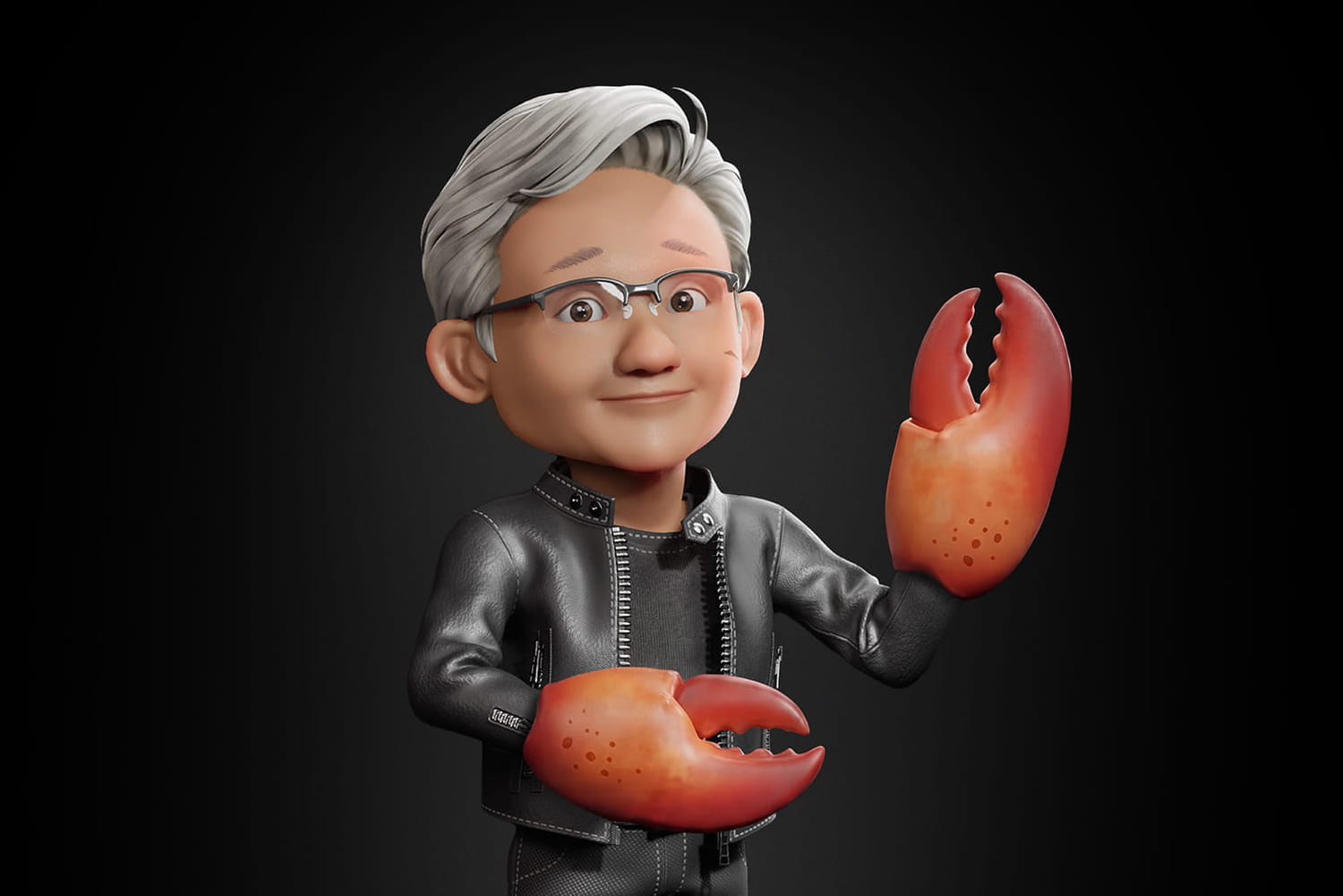
The conference ended with a strange finale, with a video clip depicting a cartoonish version of Jensen Huang gathered with robots and a Moltbook crab around a campfire, singing country music about tokens and open source AI while accompanying himself on the banjo. We will let the reader appreciate it… or not.