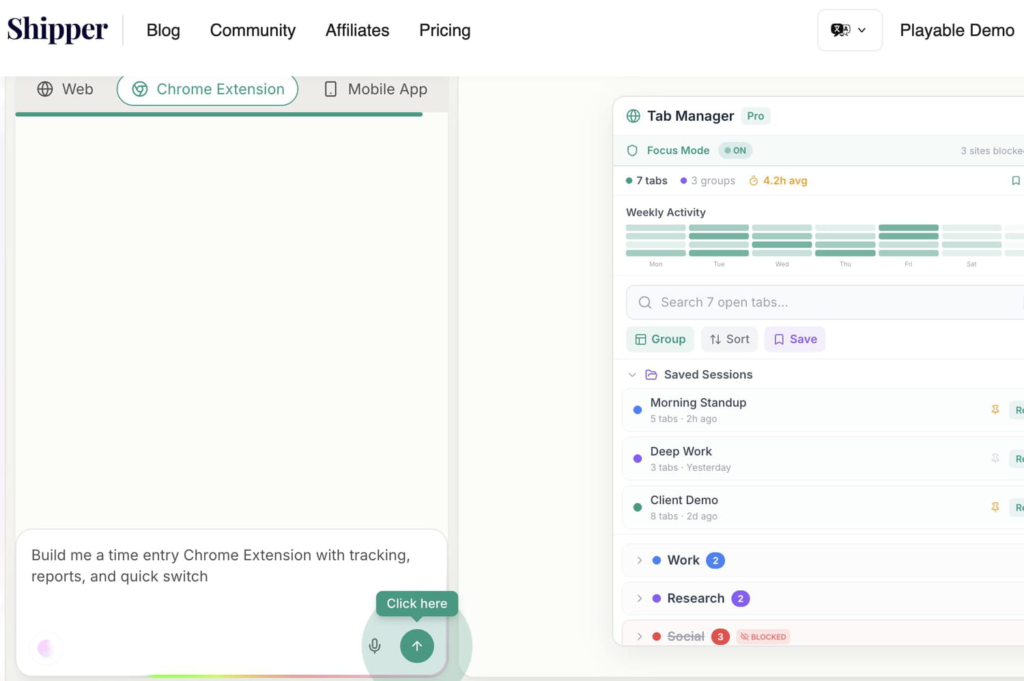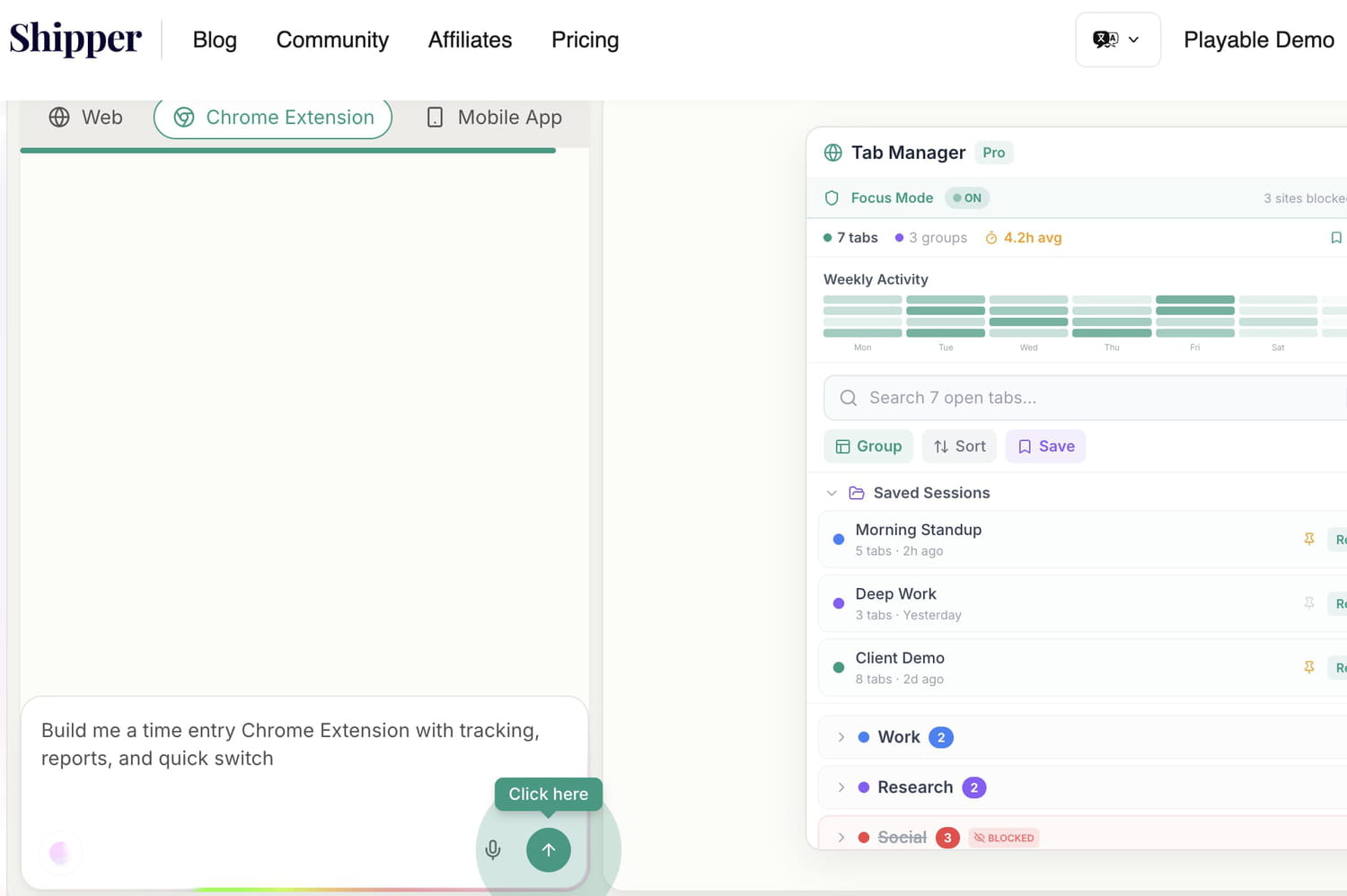
Shipper.now claims to allow you to go from an idea to a deployed app without touching the code. Effective for prototyping, less transparent on the final invoice.
While AI has profoundly simplified the development of applications and websites, putting an MVP into production remains a journey fraught with technical pitfalls. Several no-code and low-code tools – Lovable, v0, Bolt – already occupy this segment, but most stop at the prototype: moving to a truly deployed application, with hosting, authentication and payment, still requires a considerable integration effort. It is precisely this barrier that Shipper.now intends to break down. Founded in August 2025 by serial SaaS entrepreneurs based in London, the platform promises to compress as much as possible the time between the idea of a product and its concrete launch, exportable code and live URL to boot. The JDN was able to test the tool.
Based on Claude Opus 4.6
Shipper.now is based on Claude Opus 4.6 from Anthropic. The model powers its entire generation chain. The principle is deliberately simple: the user describes in natural language the application he wishes to build and the platform takes care of the rest. Behind the scenes, AI agents break down the request, design the database schema, generate the frontend and backend, wire up the authentication, and finally configure the deployment. The entire process is visible in real time via a virtual queue (in the form of a plan) which details each step.
Once the application is generated, the user can modify their web application either using a visual editor, without touching the code, or by using an AI copilot. The AI is capable, on paper, of suggesting features to add, proposing a roadmap and can apply the modifications itself after validation. On the integration side, Shipper announces connectors with Stripe for payment, Google Workspace, Shopify, ChatGPT and ElevenLabs. The goal is to have a functional application as quickly as possible without lengthy configuration. Deployment is done in one click, the application is immediately accessible on a URL provided by Shipper. The stated objective is clear: to do without the development, configuration and hosting of your application to minimize the production time.
A unique Pro plan and a credit system
Shipper.now opts for a unique model: a single Pro subscription, billed at 25 dollars per month (22.56 euros) per user. The price then varies depending on the number of credits needed to develop and configure your application. The entry level offers 100 credits per month for $25, and the user can increase up to 5,000 monthly credits ($1,125) by remaining on the same plan architecture, simply by adjusting their needs. Regardless of the level chosen, all the features are included. The platform puts forward a shocking argument on its pricing page: the cost of an offshore developer is around $4,000 per month, where a Shipper plan with equivalent capacity would be, theoretically, between $50 and $100 per month. An obviously marketing calculation.
Shipper also offers a tailor-made Enterprise plan, intended for organizations with more structuring needs. This includes dedicated support, custom integrations, SSO management and, by default, exclusion of data from model training.
How to launch an application quickly?
To put Shipper.now to the test, we opted for an accessible use case: creating an online directory of restaurants with a review system, filters by type of cuisine and geolocation. A seemingly simple project, but which still involves several building blocks: database, user accounts, search interface, map display.
After creating an account with a Pro subscription, we give the following prompt to the AI:
Crée un annuaire complet de restaurants structuré autour d'une page d'accueil dynamique. En haut, une barre de recherche permet de filtrer par nom, type de cuisine (via un menu déroulant : Italien, Japonais, Français, Street Food) et localisation. Juste en dessous, affiche une carte interactive occupant 40% de la largeur qui positionne des pins pour chaque restaurant ; cliquer sur un pin ouvre une infobulle avec le nom, une photo miniature et la note moyenne. La liste des restaurants est présentée sous forme de grille de cartes affichant une image principale, le nom en grand, le quartier, le type de cuisine et un badge de note sur 5 étoiles. Le clic sur une carte mène à une fiche détaillée organisée en colonnes : à gauche, une galerie photo et la description du lieu; à droite, une barre latérale avec l'adresse cliquable (lien Google Maps), les horaires d'ouverture (avec indicateur Ouvert/Fermé en temps réel) et un bouton de réservation. En bas de page, une section Avis affiche les commentaires des utilisateurs avec leur note, la date et le nom du profil. Les utilisateurs connectés peuvent soumettre un avis via une fenêtre modale comprenant un sélecteur d'étoiles et un champ texte. L'application gère deux types de comptes via une authentification sécurisée. Les utilisateurs peuvent gérer leurs favoris. Les restaurateurs accèdent à un tableau de bord privé pour modifier leurs informations, ajouter des photos et répondre aux avis. Le design utilise une navigation intuitive avec un header fixe contenant le logo, les liens vers les catégories et les boutons de connexion/profil. Un pied de page regroupe les mentions légales et les réseaux sociaux. L'interface doit inclure des états de chargement (skeletons) et des messages d'erreur clairs si aucun résultat n'est trouvé.
In a few moments, the builder automatically divides the project into three sequential phases: technical base and interface, authentication and interactive features, restaurant dashboard. The AI agent executes each step in order with the progress visible live. Code generation takes approximately 60 minutes.
Shipper.now produces a clean, functional and already structured site, with a neat user interface on the front side and an operational back office on the restaurant side. On the other hand, there was a nasty surprise when it went online: activating the Shipper Cloud, the managed backend of the platform, is essential for the application to actually work. It provides the integrated database for storing form submissions, user accounts, content generated by the application and any structured data. For our test, we had to add $5 in cloud credits (the minimum) just to get the site up and running. A modest additional cost in itself, but which is added to the 25 monthly dollars of the Pro plan and does not appear clearly in the displayed price list. Damage.
A quick MVP generator
Shipper.now keeps part of its promise. The tool excels at quickly producing neat interfaces and landing pages that are slicker than what Lovable offers. It is therefore a relevant tool for non-technical entrepreneurs who want to pitch a project to investors or produce an MVP before committing a development budget. For simple projects (showcase site, directory, small internal tool), the result is correct. On the other hand, as soon as we touch on the backend and more advanced business logic, the back and forth with the AI multiplies and the generation time lengthens considerably, to the point of sometimes being longer than what a developer would obtain with a classic Claude Code. But Shipper is not aimed at technical profiles.
Furthermore, pricing transparency leaves something to be desired, activating the Cloud module generates an additional cost which does not appear clearly in the displayed price grid. The marketing promise is therefore not entirely kept. For ambitious applications, it will be necessary to spend a significant amount of time and accept numerous iterations. The service nevertheless remains solid for what it is today: a business-oriented prototyping accelerator.