
curation
I just subscribed to 60 blogs via RSS and maybe you should, too
Over the past years, I have been outsourcing increasing parts of my news/content discovery to the social web, following the famous mantra “If it is important, it will find me”. Today I am changing course.
I decided that I want to decrease the reliance on my social graph for what I read. Both Facebook and Twitter have entered a difficult period when it comes to the sharing and distribution of news. For Facebook, its enormous power, influence and tendency to create algorithmic echo chambers is turning into a burden, with hard-to-predict consequences. Twitter on the other hand suffers from all kinds of strategic and systemic problems, nicely summarized in this post. Some kind of radical change will be necessary for Twitter to survive and thrive. Continue Reading
The deeper meaning of Spotify’s Discover Weekly
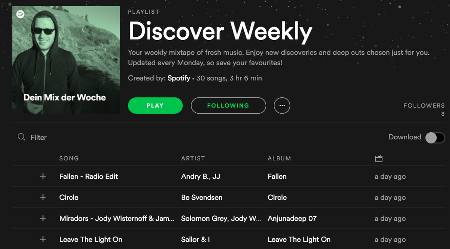
Streaming services have changed how people listen to music. But they have not changed the fundamentals of the music business: Labels sign artists, invest lots of money into turning them into sought-after superstars, and collect royalties from third parties who want to use or redistribute the music. Since most listeners would not be willing to commit to a digital music streaming service that lacks releases of the big label artists, Spotify & Co have to enter into expensive licensing agreements with the major labels. These licensing fees usually have to be paid per user and month, which makes it challenging for streaming services to ever achieve economies of scale. That explains why a service such as Spotify still isn’t profitable, despite 40 million paying subcribers: The more users it has, the more royalties have to be paid to the license owners, who then in turn pay the artists signed with them based on how popular their tunes are on the service. Here is Spotify’s own explanation of how it pays royalties.
For streaming services, the most desirable change in market dynamics would be if subscribers stopped seeing the availability of major label releases as a requirement for agreeing to pay the monthly subscription fee. So far, such an approach has not been successful for any serious contender in the streaming race. In fact, SoundCloud tried to grow without costly label deals and official licensing, focusing on independents instead, but didnt’ manage to turn this strategy into a working business model. The Berlin-based company is now adopting the conventional paid subscription model.
However, a seemingly trivial innovation introduced by Spotify last year, could lead to a paradigm shift in the streaming business: Continue Reading
The responsibilities of a curator
The Internet has led to an atomization of news. Instead of reading a specific newspaper each day and one or two magazines each week or month, an increasingly common behavior pattern among younger generations is a pick-and-choose approach. People read what they find interesting, no matter which source. The discovery of content happens mostly through social media. The publisher brands are moving into the background. Instead, friends and online contacts are representing the “seal of approval” for a specific piece of content. “If person X has recommended a text, video or podcast, I might want to check it out, because I like person X/know that person X has a similar taste, interests or worldview”.
I’ve just described the rise of the curator. In the digital context, curators are people who distribute content created by others. Nowadays most people with an interest in digital media are aware of the phenomenon. However, I argue that the majority of “regular” people, who act as curators on the big social networks and who do not follow the digital media industry’s discourse, are not aware of the implications of the curation trend. They are not aware that being a curator comes with duties and responsibilites. Continue Reading