
Snapchat
Mini-posts: Snapchat vs Facebook, app unbundling, Stockholm’s tipping point
I’m trying out a new format with a post comprising of 2-3 mini-posts about trends and news from the tech world. A maximum of 10 sentences per post.
4 billion video views
Snapchat has announced 4 billion daily video views. Usually I would not pay any attention to such a vanity metric. But in this case, the number allows for an enlightening comparison: Just a couple of months ago, in April, Facebook reached the same milestone of 4 billion daily video views (sidenote: YouTube did so in the beginning of 2012). Facebook has almost 1 billion daily active users, compared to Snapchat’s nearly 100 million daily active users. The videos on Snapchat are extremely short, presumably much shorter than those on Facebook. That aside, an average Snapchat user views 10 times as many videos a day as a Facebook user. No surprise Snapchat is so hot.
Unbundling works – for Google and Facebook
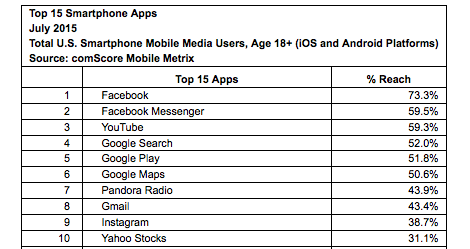
Last year, many major Internet companies started to move certain features from their existing apps into newly launched, separate apps. “Unbundling” (or “app constellations“) was the latest trend, utilized by all the big names. A new comScore report shows for which companies this has worked the best: Facebook and Google (which in fact had been relying on this strategy for quite some time already). Among the top 10 most popular smartphone apps in the U.S. on iOS and Android combined, 3 are owned by Facebook (Facebook, Messenger, Instagram), and 5 by Google (YouTube, Search, Google Play, Google Maps, Gmail). Pandora Play and Yahoo Stocks are the only apps within the top 10 that are not owned by either company. Facebook’s initially controversial move to spin-off Messenger totally paid off. Meanwhile, unbundling did not work so well for other tech giants. Related news: Just this weekend, Google released Street View as yet another seperate app.
Stockholm’s tech tipping point
The VC fund SparkLabs recently published a ranking of the 10 hottest startup ecosystems in the world, and Stockholm ranked second after the Silicon Valley. While the accuracy of these kind of reports always can (and should) be questioned, the good result of the Swedish capital did not surprise me. In fact, it seems apparent to me that the city has reached its tipping point. From now on, past success and experience helps to build new, even bigger successes, with guaranteed international attention. Last Wednesday I attended a great conference, Stockholm Tech Fest. The amount of local bigshots among the speakers who shared their insights and experiences was astonishing. Spotify CEO Daniel Ek, Skype-founder and seriel entrepreneur/VC Niklas Zennström, Klarna CEO Sebastian Siemiatkowski, Delivery Hero CEO Niklas Östberg (Berlin-based but Swedish), Truecaller Co-founder Nami Zarringhalam were among the speakers. I am truly excited about what comes next.
======
Sign up for the weekly newsletter so you do not miss any posts. Or subscribe through other channels.
The struggle to “get” Snapchat
 The 3-year old mobile communication startup Snapchat has been valued at an unbelievable $15 billion in its recent financing round. But despite several attempts, I have been failing to get hooked to the service. In my daily mobile life, Snapchat does not play any role. That makes it somewhat mysterious to me. How is it possible that the L.A.-based company is in the top 5 of the most valuable pre-exit technology companies, yet I do not see its fascination?! And it’s not only me. I have sufficient indications to safely assume that a major part of my network of friends, acquaintances and online contacts are not active Snapchat users.
Here is the explanation: Snapchat started as a phenomenon among teenagers. 3 years later, it is still mostly embraced by young user groups, lets say estimated 25 years and younger (college students and younger). My friends and contacts are mostly older.
Among U.S. teens, Snapchat is almost as popular as Instagram. A recent report by GlobalWebIndex confirms an equally high popularity among teens in Canada, the UK, Australia and some other countries. I am not aware of any survey that suggests a significant usage of Snapchat among people in the age group 30+. But what I am aware of are dozens of articles with headlines like “16 Things Old People Don’t Understand About Snapchat” or “Is Snapchat Really Confusing, or Am I just Old?” that you can find when performing a web search for “Snapchat + old”. Continue Reading
How everybody was wrong about the future of Social Networking
Lots of things have changed over the last years in the digital world. To me, one of the most surprising developments has been the quite significant turn of events in the social networking sector:
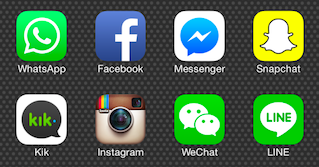
Today, with some exceptions, the public stream- and profile-based one-to-many-communication as a means of communication between friends looks like a rather outdated concept. Instead, mobile messengers that are based on the concept of private communication between 2 or a group of selected people are becoming the major social networks. According to a fresh forecast (via), in 2015 the world’s 4 biggest smartphone messengers Whatsapp, Facebook Messenger, Line and WeChat will probably end up reaching more users than the 4 biggest “traditional” social networks Facebook, LinkedIn, Twitter and Instagram.
When Facebook launched the newsfeed in 2006 and consequently took over the world in the following years, few expected a situation like the one today. Back then, the industry consensus was that private conversations would move into the public sphere, enabled and pushed by Facebook and Twitter. More than once Facebook made controversial changes to its privacy settings that were aimed at stopping users from publishing status updates with contact-only visibility. Also, for a long time, Facebook’s private messaging feature was pretty underdeveloped. Twitter’s is still today (the company promised to improve that soon).
But then, something happened. A couple of years after the pioneering debut of the iPhone, smartphones became gadgets for the masses. At first, Facebook was slow to adapt to the changing usage patterns and technical environment. Meanwhile, companies such as WhatsApp, Kik, Naver (makers of Line) and Tencent (makers of WeChat) saw potential to reinvent the venerable SMS by making it more interactive, less limited, and – of course – free. Shortly after, Snapchat followed with a slightly modified, but equally privacy-aware approach. All these services grew rapidly, and with the exception of Snapchat pretty much unnoticed by the Californian Internet industry. While traditional texting remained popular in the U.S. due to a different fee structure and the popularity of iMessage (which is an OTT messenger but feels more like classical texting), WhatsApp took over many parts of the world, while Line (and to some extent KakaoTalk) captured most Asian markets. Meanwhile, WeChat gathered hundreds of millions of Chinese users.
Facebook’s $21.8 billion acquisition of WhatsApp, announced in February 2014, ended the industry’s and media’s ignorance of the messaging phenomenon. 4 years after Facebook CEO Mark Zuckerberg declared the age of privacy over, his stance had completely changed. While watching the rise of messaging apps he could not else but realize that the people’s desire to communicate intimately and not connected to an online-identity was stronger than his power to force them into public communication (motivated by the assumed advertising potential). Consequently, Zuckerberg decided to heavily promote Facebook Messenger while letting WhatsApp keep growing organically. He supported the new strategy with public remarks in which he basically admitted that his views on privacy and online identities had evolved.
Now, at the beginning of 2015, the situation looks perfect for messengers and at least partially gloomy for (semi) public, feed-based social networking as a tool for social-graph-based communication such as the original Facebook. While Facebook still grows as a whole, the active user number includes everybody who is logged in to Facebook anywhere, and it also includes people who only use Messenger. Frequently reports appear that show a growing neglect of the original Facebook by younger user groups. In addition there are signs that the usage of traditional social networks is dipping in some countires. Also, while still hundreds of millions of people regularly scan through their news feed, the excitement and appreciation has completely disappeared. Complaints about what’s been shown in the news feed are widespread. Studies even haven shown that the Facebook feed creates dissatisfaction and other negative emotions among users. That too might be one factor why people move to private chats with close friends and groups of preferred people. If you are like me then you have multiple ongoing group chats that do not have a beginning or an end – they are like a stream, but with people who closely interact with each other; people that do not annoy you and are relevant to you.
Today, WhatsApp has more than 600 million monthly active users. Facebook Messenger has more than 500 million, WeChat has 438 million, Line 170 million and Snapchat reportedly more than 100 million (the company does not publish official numbers). In 12 months from now, all these numbers will likely be much higher. Eventually, every owner of a smartphone in every country will likely use at least one of these services, probably even multiple ones. Unlike with traditional social networks that require users to actively check their streams, the push-based nature of messengers enables smartphone owners to use several messengers without too much mental costs.
It’s safe to assume that more messenger apps will turn into fully-fletched platforms, modelled after WeChat and Line that already follow this path. Over time these services are being transformed into hybrid solutions, trying to include the best from both the feed-based social networking and the chat-based messaging. Kik’s recent launch of a hashtag feature is another example of how that can look like.
Also, companies and brands will increasingly jump on the trend, encouraging messaging app makers to improve existing and launch new tools for b2c-interaction inside messengers. I really want to be able to quickly message stores or restaurants, something Path Talk is experimenting with. Already now there are startups that are completely reliant on WeChat, like the Chinese food delivery startup “Call a Chicken” that recently got funded. We can expect more of that. My guess is that Facebook might try to turn Messenger into a platform while keeping WhatsApp simple and focused. Having 2 successful horses in the race is quite a comfortable situation.
Messengers aside, there is one side-trend happening, which is Instagram. With more than 300 million active users, the idea of using photos (and videos) as an instrument for semi-personal one-to-many communication has proven to be a winner. Instagram is special because it can be used for social graph-based communication (= interacting with actual friends) as well as for interest graph-based communication (= interacting with/following strangers based on personal/shared interests). This is just anecdotal but I know people who have completely abandoned Facebook and use now a combination of Instagram and WhatsApp (or other messengers) to satisfy their social networking needs. I do not rule out that this becomes a widespread phenomenon. Somebody posting a text on Facebook about a good steak he/she had might only lead to yawns in 2015. If it even gets shown in contact’s news feeds. But a photo of that steak on Instagram usually receives a bunch of likes. It’s the power of visuals.
The past 8 years of social networking teach some interesting lessons:
- No matter how smart people are, their capabilities of anticipating future technology trends and usage patterns are rather limited. I do not recall anybody who predicted the messaging trend back in 2008.
- No matter how much smart people with power want others to behave in a certain way (like Zuckerberg’s no-privacy vision), it does not always work out.
- Mark Zuckerberg might have been wrong at first, but after he realized that, he acted quickly, which paid off: No matter what happens with the original Facebook in 2015 – with Messenger, WhatsApp and Instagram, the company is very well positioned.
- As usual, in hindsight, trends look obvious (it’s called the hindsight bias): The SMS was a massive success for a reason: People like texting on their phones. They also like to save money. Messaging apps are the logical result.